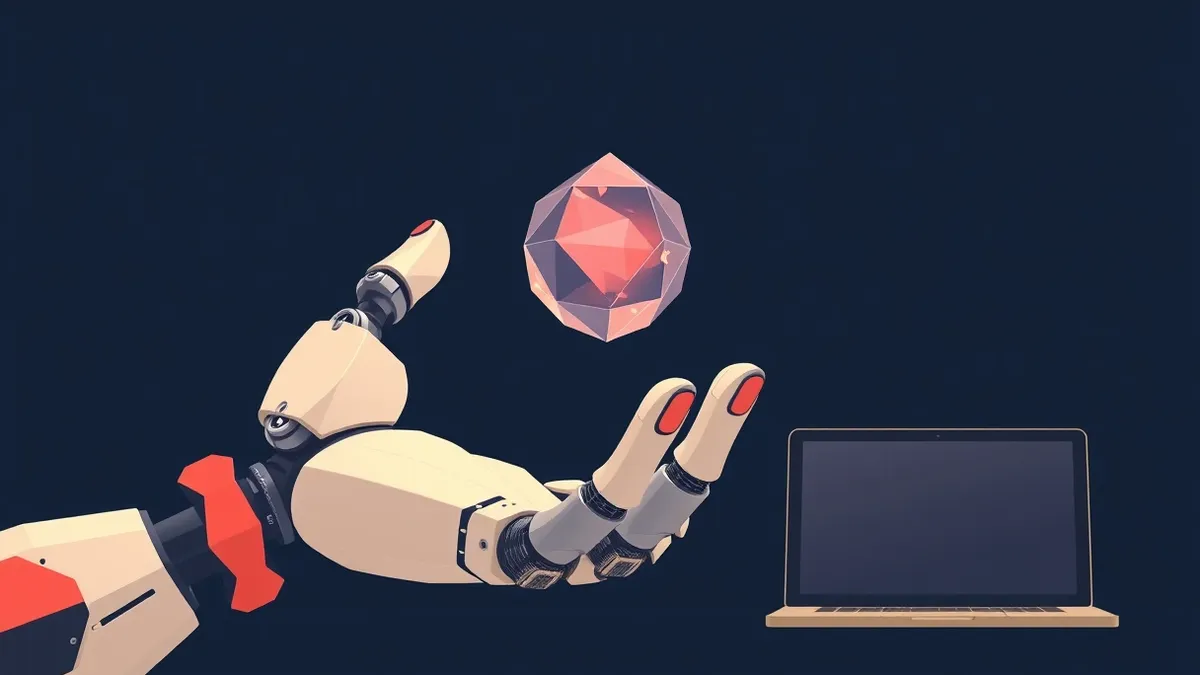
AI system proves quantum computing conjecture; Meta unveils tactile sensing glove
Physical Superintelligence reports an automated proof of a longstanding quantum theory, while Meta details new haptic hardware for robotics research.
Key points
- Physical Superintelligence settled the Aaronson-Ambainis conjecture using an internal AI system and Lean verification.
- The system had a complete proof on the third day, then improved the result twice on related problems.
- Meta Reality Labs published details on Tactus, a textile-integrated glove for collecting naturalistic manipulation data.
Physical Superintelligence reported that an internal research system has proved the Aaronson-Ambainis conjecture, a longstanding question in quantum computing theory.reported The startup stated that the system, running a non-public Anthropic model, generated a complete proof within three days of operation.An AI system created by a startup has solved a difficult math problem about quantum computers that experts had not solved for years.Physical Superintelligence leveraged a non-public Anthropic model to generate a Lean-verified proof of the Aaronson-Ambainis conjecture. This development was highlighted in the Import AI newsletter as a significant step in automated scientific discovery.
Evidence: reported
Import AI 480: Self-sustaining space economies; AI for science progress, and Meta builds perfect hands for a superintelligenceaifleet-importai
How we got here
The Aaronson-Ambainis conjecture, open since 2008, concerns the conditions under which quantum computers can achieve exponential speedups over classical machines. Scott Aaronson and Andris Ambainis originally formulated this problem, which has remained unresolved for nearly two decades. It represents one of the fundamental questions regarding the theoretical limits of quantum computational power compared to ordinary computing systems.
What is new
Physical Superintelligence’s system produced a proof that was accepted by Lean, a formal proof assistant that checks every logical step. The startup noted that after finding the proof, the system worked on related open problems and improved the result twice, with Lean accepting the final version. This process demonstrates a workflow where synthetic researchers extend knowledge frontiers, generating results that humans must then interpret and understand.
What to watch
Meta Reality Labs Research published details on Tactus, a new tactile and pose sensing glove. The device is designed from the ground up for naturalistic manipulation data collection. It integrates textile sensors to capture detailed haptic information, aiming to provide the physical interface capabilities required for advanced autonomous agents and robotic manipulation tasks.
Availability and limits
The AI model used by Physical Superintelligence is non-public, meaning developers cannot replicate the specific inference run independently. The proof itself is available through the startup’s blog post, but the underlying system architecture remains proprietary. Meta’s Tactus glove details are published, but access to the hardware or its associated datasets for external researchers has not been specified in the source material.
Why it matters
- Developers can observe a shift towards fully automated theorem proving, where AI systems handle complex mathematical verification without direct human guidance.
- The use of Lean as a verification layer provides a concrete example of how formal methods can validate AI-generated scientific claims.
- Meta’s Tactus glove highlights the growing importance of tactile data collection for building robust robotic manipulation agents.
- The narrative suggests that AI systems are moving from pattern recognition to extending the bounds of human knowledge in fundamental sciences.
Topics: quantum computing, AI research, robotics, Meta, Physical Superintelligence
Updated
Then / now / next
The Aaronson-Ambainis conjecture had remained open and unresolved since 2008.
An AI system has produced a proof accepted by the Lean verification assistant.
The system was set to work on related open problems after the initial proof.
Story timeline
- Then The Aaronson-Ambainis conjecture had remained open and unresolved since 2008.
- 09 Nov 2026 Import AI 480: Self-sustaining space economies; AI for science progress, and Meta builds perfect hands for a superintelligence
- Now An AI system has produced a proof accepted by the Lean verification assistant.
- Next The system was set to work on related open problems after the initial proof.
For readers
Researchers
- Physical Superintelligence’s blog post provides details on the proof of the Aaronson-Ambainis conjecture.
- The system improved the result twice, demonstrating iterative refinement in automated research.
Developers
- Lean verification offers a method to validate AI-generated mathematical proofs.
- Meta’s Tactus glove illustrates new approaches to collecting manipulation data for robotics.
Investors
- AI science startups like Physical Superintelligence are producing tangible scientific outcomes.
- Hardware innovations like tactile gloves support the broader autonomous agent ecosystem.
Ask the article
Local keyword search of this article; no generated answers.Did this article give you the evidence you needed?
Your choice stays on this device. No public tally.Questions readers ask
What conjecture did the AI system prove?
The system proved the Aaronson-Ambainis conjecture, which addresses when quantum computers can be exponentially faster than classical ones.
Was the AI model used public?
No, Physical Superintelligence stated that the system ran on a non-public Anthropic model.
What is the Tactus glove used for?
It is designed for naturalistic manipulation data collection, integrating tactile and pose sensing for robotics research.
Connected stories
Reading receipt
- Physical Superintelligence settled the Aaronson-Ambainis conjecture using an internal AI system and Lean verification.
- The system had a complete proof on the third day, then improved the result twice on related problems.
- Meta Reality Labs published details on Tactus, a textile-integrated glove for collecting naturalistic manipulation data.