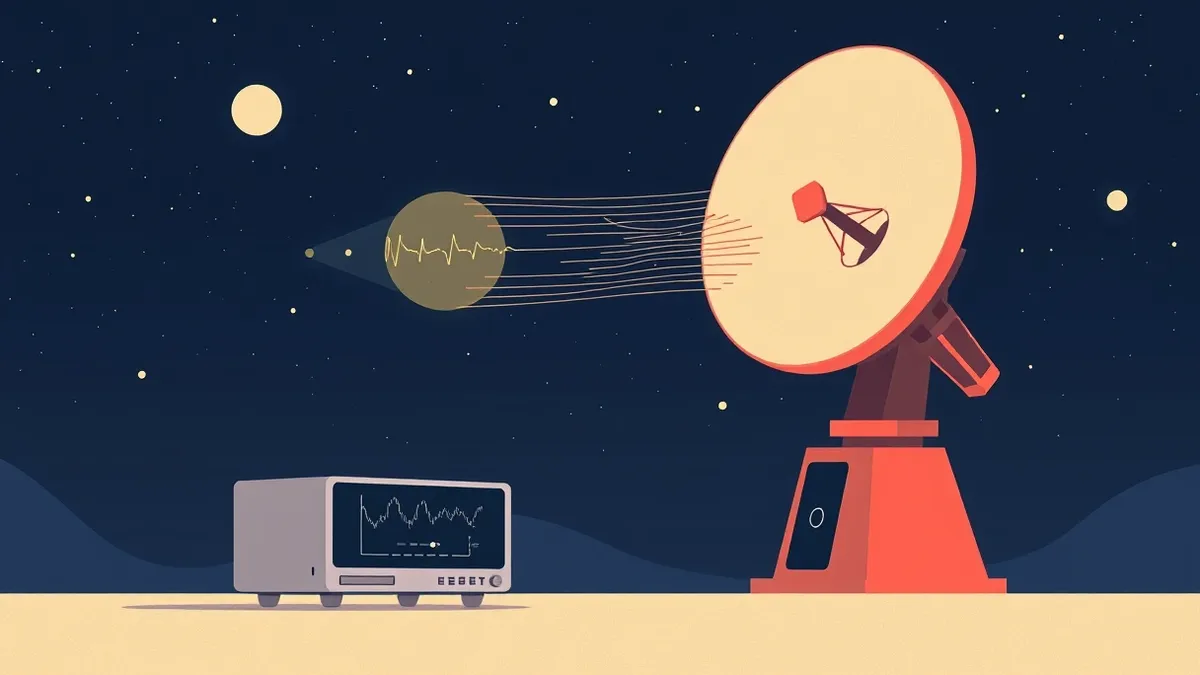
AI agents control SETI telescope, detecting Crab Nebula pulsar in real time
Nvidia Holoscan powers real-time signal analysis at the Allen Telescope Array, compressing weeks of work into hours for researchers.
Key points
- AI agents now steer the Allen Telescope Array and analyse radio signals in real time.
- The team detected a Crab Nebula pulsar in real time using AI, a first.
- Nvidia Holoscan hardware handles up to 2.4 terabits per second of data throughput.
AI agents are now steering the Allen Telescope Array in Northern California, controlling telescope movements and analysing incoming radio signals on the fly, according to a report by The Decoder.reported
Evidence: reported
AI agents take over at SETI's Allen Telescope Array, scanning for extraterrestrial intelligenceaifleet-decoder
How we got here
Researchers have searched for extraterrestrial intelligence since 1960, but no confirmed signals from alien civilisations have been found to date.reported Traditional analysis of radio telescope data was a slow process, often taking weeks to complete basic tasks and evaluations.
Evidence: reported
AI agents take over at SETI's Allen Telescope Array, scanning for extraterrestrial intelligenceaifleet-decoder
What is new
The SETI Institute and Breakthrough Listen have deployed Nvidia’s Holoscan platform to process telescope data in real time. This hardware can process up to 2.4 terabits per second, allowing tasks that previously took weeks to wrap up in hours.reported
Evidence: reported
AI agents take over at SETI's Allen Telescope Array, scanning for extraterrestrial intelligenceaifleet-decoder
What to watch
The team aims to test open-source software that can run locally on edge devices. This development targets future sensors planned for the far side of the Moon, requiring autonomous processing capabilities away from Earth.
Availability and limits
Currently, researchers still type in their own commands to operate the system; the AI agents do not fully automate decision-making without human input. The system is currently in use by the SETI Institute and Breakthrough Listen at the Allen Telescope Array.
Why it matters
- Demonstrates high-throughput edge AI processing for scientific sensor data at terabit scales.
- Shows potential for real-time anomaly detection in continuous radio signal streams.
- Highlights a pathway for autonomous AI operation in remote, low-latency environments like lunar sensors.
- Shows Nvidia Holoscan being used for real-time scientific data ingestion and analysis.
Topics: AI agents, SETI, Nvidia, edge computing, radio astronomy
Updated
Then / now / next
Signal analysis tasks took weeks to complete using traditional methods.
AI agents process data in real time, reducing task duration to hours.
The team plans to test local, open-source edge computing for lunar sensors.
Story timeline
- Then Signal analysis tasks took weeks to complete using traditional methods.
- 03 Nov 2026 AI agents take over at SETI's Allen Telescope Array, scanning for extraterrestrial intelligence
- Now AI agents process data in real time, reducing task duration to hours.
- Next The team plans to test local, open-source edge computing for lunar sensors.
The strongest doubt
Counterpoint from the sources
It remains uncertain whether these AI agents will ever detect actual extraterrestrial intelligence, as no such signals have been found in decades of searching.
Ask the article
Local keyword search of this article; no generated answers.Did this article give you the evidence you needed?
Your choice stays on this device. No public tally.Questions readers ask
What hardware powers the new AI agent system?
The system runs on Nvidia’s Holoscan platform, which processes up to 2.4 terabits per second.
Has the system detected extraterrestrial intelligence?
No, it detected a known pulsar in the Crab Nebula as a test case for signal detection.
Can the AI control the telescope entirely on its own?
No, researchers still manually type in commands for the system to execute.
Connected stories
Reading receipt
- AI agents now steer the Allen Telescope Array and analyse radio signals in real time.
- The team detected a Crab Nebula pulsar in real time using AI, a first.
- Nvidia Holoscan hardware handles up to 2.4 terabits per second of data throughput.
Still open: Will the system be open-sourced for broader developer access?
Still open: How will the edge computing tests perform in lunar simulation environments?